
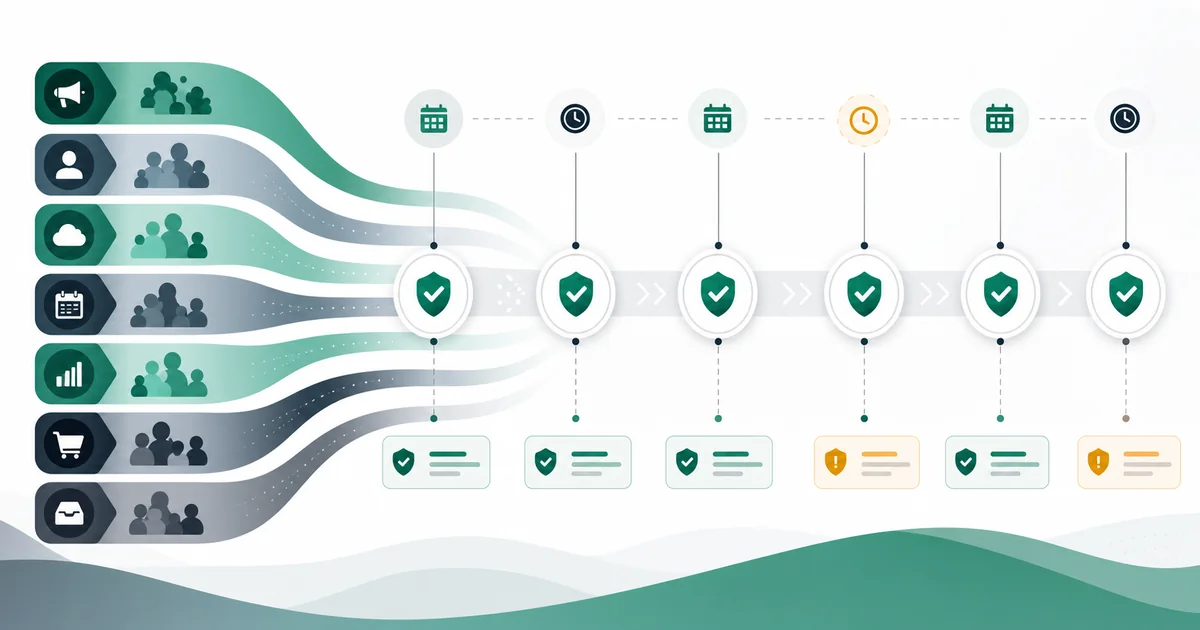
Reverify an email list when the cost of stale evidence becomes meaningful, not simply because a fixed number of days has passed. The right schedule depends on how the addresses were collected, when they were last active, what you plan to send, and whether warning signals have appeared. Verify sooner before a high-impact campaign or after a long pause. Verify less often for recently confirmed, actively engaged records.
A verification result describes evidence at a point in time. People leave companies, domains expire, mail routing changes, inboxes fill, security gateways change, and addresses are corrected. Reverification updates technical evidence. It does not renew consent or erase a suppression.
Use a schedule as a review trigger, not a guarantee
| Use case | Practical trigger | Check sooner when |
|---|---|---|
| Active marketing subscribers | Before a major send if verification is no longer recent | Bounces rise, engagement stops, or the list was merged |
| Approved cold outreach data | Close to enrollment because work addresses change | The source is old, roles changed, or the campaign was delayed |
| SaaS users | On address change or before a high-impact dormant-account flow | Transactional mail bounces or recovery is requested |
| Ecommerce customers | At correction, account update, or before reactivation | Order messages fail or an old guest record is reused |
| CRM database | In source-based maintenance batches | Imports, migrations, enrichment, or deduplication changed records |
| Event attendees | Before operational reminders if registration is no longer recent | The event moved or the list includes copied historical contacts |
| Partners and vendors | During relationship review or before a critical notice | A contact changed role or the domain changed |
| Dormant records | Before any reactivation decision | There has been no recent engagement evidence |
The table deliberately avoids a universal day count. Your cadence should be based on observed change, send frequency, data source, and risk tolerance. Document the chosen windows in your verification policy and review them using real outcomes.
Marketing lists: verify around campaign risk
Active subscribers with recent engagement and clean delivery history need less intervention than an old segment that has not been mailed for months. Apply opt-outs and suppression first. Then reverify the addresses whose technical evidence is stale enough to affect the planned send.
Before a large or reputation-sensitive campaign, freeze the audience early enough to process results and review risky or unknown records. Do not verify after the final audience has already entered the sending platform. Keep a control record of the source count, unique processed addresses, result buckets, exclusions, and final campaign audience.
Cold outreach lists: keep checks close to approved use
Business addresses can change quickly when people move roles or companies. If your organization permits prospecting, validate the lawful source and relevance before spending effort on technical checks. Verify close to the approved enrollment date, especially when a purchased timestamp or enrichment date is old.
Verification does not make scraped or noncompliant data acceptable. It also does not prove that a role inbox belongs to the intended person. Apply role, catch-all, and unknown policies separately, and stop contacting recipients according to your suppression rules.
SaaS users and ecommerce customers: respond to events
For an active account, routine repeated probing may add little value. Reverify when the user changes the address, a transactional message produces a durable failure, or a dormant account is entering a high-impact reactivation or recovery flow. Use an ownership-confirmation message when the product must establish control of the mailbox, since verification alone cannot do that.
Do not block account access solely because a later check is unknown. The mailbox may be behind a protected gateway or a temporary failure. Design an escalation path that considers authenticated account access, recent purchases, and support evidence.
CRM databases: segment by provenance
A CRM is not one list. Separate recent inbound leads, active customers, newsletter subscribers, partner contacts, former opportunities, and imported historical data. Give each source its own schedule and decision rules. This prevents low-quality legacy records from forcing unnecessary checks on active contacts.
Reverify after a migration or merge when email fields may have been remapped, normalized, or deduplicated. Preserve the original source ID and prior result so the operation remains reversible. Run large permission-based segments through the bulk email verifier, which accepts CSV and XLSX and processes unique normalized addresses once per job.
Event and partner lists: follow the relationship clock
Event data often has a short operational window. Check at registration or close enough to reminders that a correction can still reach the attendee. If an event is postponed, reassess the list before restarting communication. Do not carry attendees into unrelated marketing without the appropriate permission.
Partner and vendor contacts may remain useful for years, but named employees and aliases change. Review them when ownership changes, during a relationship review, or before critical operational notices. A shared departmental inbox can be more durable than a named contact and should not be rejected merely for being role-based.
Dormant records need more than reverification
An old address that verifies is still an old relationship. Before reactivation, check consent, suppression, purpose, and engagement history. Reverification can remove clear technical failures and separate uncertain records, but it cannot reset permission or guarantee renewed interest.
Keep dormant and active segments separate throughout the process. That lets you measure the quality of the old cohort and stop a problematic reactivation without affecting routine communication.
Warning signs that justify an early check
- A sustained increase in hard bounces or unknown recipients from a previously stable source.
- A long pause since the segment last received mail.
- A new import, merge, enrichment provider, form, or manual data-entry process.
- A company-domain change, acquisition, rebrand, or widespread employee turnover.
- Many corrected addresses, malformed values, or duplicated records in a source system.
- An upcoming high-volume or high-impact campaign.
- Repeated temporary responses that need a controlled retry segment.
- A mismatch between stored verification decisions and current suppression data.
Investigate the source as well as the symptom. Reverification will not fix a broken form, incorrect field mapping, poor consent flow, or failure to remove real campaign bounces. The bounce reduction guide covers those additional controls.
What should not be repeatedly reverified
Do not repeatedly check conclusive syntax failures, domains with decisive permanent failures, or addresses already suppressed for opt-out or complaint reasons. Suppression evidence must remain effective even if the address later appears technically usable. Do not spend verification cycles trying to prove ownership, since a confirmation workflow is required for that question.
Do not recheck an entire database because a small source segment degraded. Target the affected cohort. Avoid tight retry loops for greylisting or protected providers. A bounded later retry can be useful; repeated probing does not force an external server to disclose a mailbox.
Build a repeatable reverification run
- Define the business event and select one source cohort.
- Apply consent, opt-out, complaint, and suppression rules before verification.
- Preserve source IDs, original values, prior status, and prior check time.
- Deduplicate normalized addresses for processing while retaining row relationships.
- Verify through bulk upload or an approved API job.
- Separate valid, risky, invalid, and unknown results without deleting the original file.
- Retry only eligible temporary conditions under a bounded policy.
- Write the result timestamp and business decision back to the system of record.
- Measure later bounces and corrections by source to tune the next schedule.
This feedback loop turns a calendar guess into an evidence-based maintenance program. Keep the process aligned with the broader list cleaning workflow, which also covers inactivity, duplicates, and database updates.
Reverify the cohort that needs attention
Prepare a permission-based CSV or XLSX segment and use the Mailthentic bulk verifier while preserving the original records and suppression state.
Ready to verify your email list?
Start free with 250 verification credits. No credit card required.